
Yerington, Nevada · Lyon County
Excel Consulting Services in Yerington, NV
Yerington runs on ground and water. Alfalfa, onions and garlic out across the Mason Valley, a county seat that carries the paperwork for the whole of Lyon County, and a copper mine on the edge of town that stopped producing decades ago and still generates more reporting than most working businesses do. JAAD Group builds and repairs the spreadsheets underneath all of it — remotely, so being three hours from a city changes nothing about what you get.
- Farm and field costing
- County budget reporting
- Reclamation records
- Workbook repair
What the Mason Valley actually keeps in Excel
Farm Ground, County Files and a Mine That Never Stopped Reporting
Three kinds of record-keeping dominate this valley, and none of them looks like the office spreadsheets most consultants have spent their careers on. Growing seasons that outlast any budget cycle, public submissions read by people you will never meet, and environmental documentation that has to survive being reopened a decade after it was filed.
Start with the farms, because they set the pattern. A grower here is tracking yield, water allocation, input cost and delivery against contract across ground that may be owned in one place and leased in three others. The natural way to record that is a tab per field, which works beautifully for two seasons and becomes unreadable by the fifth. By then nobody can answer the only question that matters — which ground actually paid this year — without a week of manual comparison. Restructuring that is ordinary Excel consulting work rather than a rebuild.
Then there is the county. Lyon County is administered from here, and a county seat produces submissions on fixed dates regardless of how many people are available to produce them. Budgets, headcount, procurement records: obligations sized for a much larger organization, landing on a team that also has to answer the phone — the case for automating the recurring returns is strongest exactly here.
And the Anaconda site sits on the western edge of town, still an active reclamation project long after the copper stopped. The contractors working it produce sampling results, disposal volumes and site condition records that have to stay defensible for years, which is a structural demand on a spreadsheet rather than a formatting one, and it is closer to financial modeling discipline than to bookkeeping.
The underlying pattern
Why Mason Valley Records Break the Way They Do
Everything here outlasts a reporting period
What connects those three is horizon. Most business reporting answers a question about the month that just ended. Almost nothing in the Mason Valley does. A field's performance only means something across seasons; a reclamation record is written for a reader who does not exist yet; a county budget submission is compared against ones filed years earlier. Workbooks built for monthly reporting fail at this quietly — not by producing wrong numbers, but by making the long comparison impossible without rebuilding the history by hand every time somebody asks for it. The same failure shows up in Fallon's water records and in Lovelock's seed contracts, for the same structural reason.
One person is usually the entire process
The second thread is concentration. In a town of roughly three thousand, the person who maintains the spreadsheet is usually also the person who runs the operation, files the return and answers the phone. That is not a resourcing complaint, it is a design constraint. A tool that requires its author to be available is a tool that stops working the week they are irrigating, on jury duty, or simply away. Documentation stops being a nice-to-have and becomes the difference between a system and a liability. This is why training the team forms part of every handover.
Almost every number is read by an outsider
The third is that almost everything here has an external reader. Grower contracts, county submissions, environmental filings — the figures leave the building and get examined by somebody with no context and no way to ask a follow-up question. A workbook built for internal use can get away with an assumption living inside a formula. A workbook whose output is read by a regulator, a funder or a contracting party cannot, because when the question comes it arrives years later and the person who knew the answer has moved on.
None of this requires new software
None of that requires new software. It requires the existing files to be structured as data rather than as a stack of annual sheets, with the assumptions written down where somebody looking for them will actually find them. That is most of what this work is, and it is why an hour of expert help often resolves more than a project would.
What we do
Excel Consulting Services for Yerington Businesses
Six areas of work. In practice a Mason Valley project usually starts in one and quietly pulls in a second before it finishes.

Structure
Workbook Restructuring & Repair
The most common job in this valley is not building something new. It is taking a file that grew a sheet at a time over eight seasons and giving it a spine, so the history it already contains becomes something you can actually query.
- Tab-per-field consolidation — one data layer, with per-field views over the top
- Season-over-season comparison that survives ground changing hands
- Formula repair — the lookups that quietly stopped pointing anywhere
- Speed — array formulas and volatile functions replaced with tables and pivots
Related: Excel consulting
Automation
Automating the Returns You File Every Period
County submissions, grower reports and contract reconciliations get rebuilt from scratch each cycle in most offices this size. They should be generated. The inputs are the same every time, which is exactly the condition automation needs.
- Recurring submissions that assemble themselves from your own records
- Multi-source consolidation when the data arrives in three shapes
- Scheduled refresh so the figures are current without anyone clicking
- Import cleanup for exports that never quite match the last one
Related: Excel automation

Code
VBA and Macro Development
When the built-in features run out, we write code. In a small office that usually means a tool with a form on the front, so data goes in clean and nobody has to remember which cell must not be typed over.
- Entry forms that validate at the point of entry rather than afterwards
- Multi-step routines that run identically every single time
- Inherited macro repair when the author has long since left
- Add-ins where several people need the same tool without circulating copies
Related: VBA and macro development
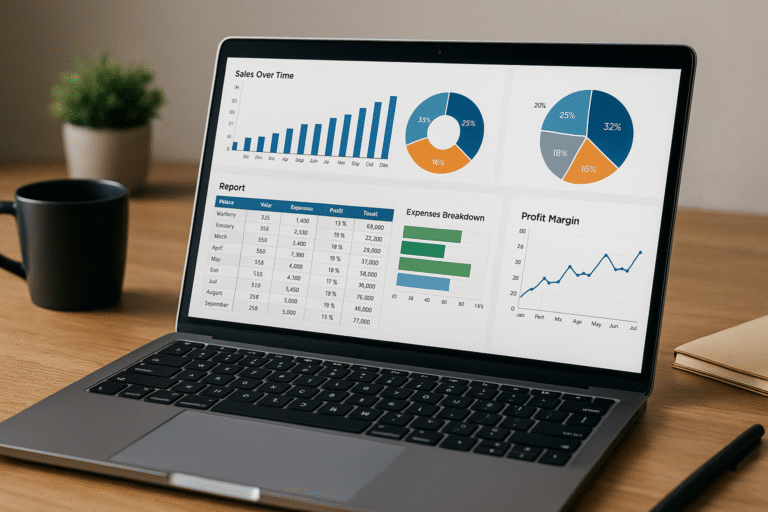
Reporting
Reports and Dashboards Worth Reading
A report earns its keep when somebody changes a decision because of it. For operations this size that rarely means a wall of charts — it means the two or three numbers that move, on one page, current enough to act on.
- Field and cost comparison across seasons rather than months
- Board and council packs formatted for an outside reader
- Live connections to the systems that hold the source data
- Exception flags so a mismatch announces itself
Related: Excel reporting
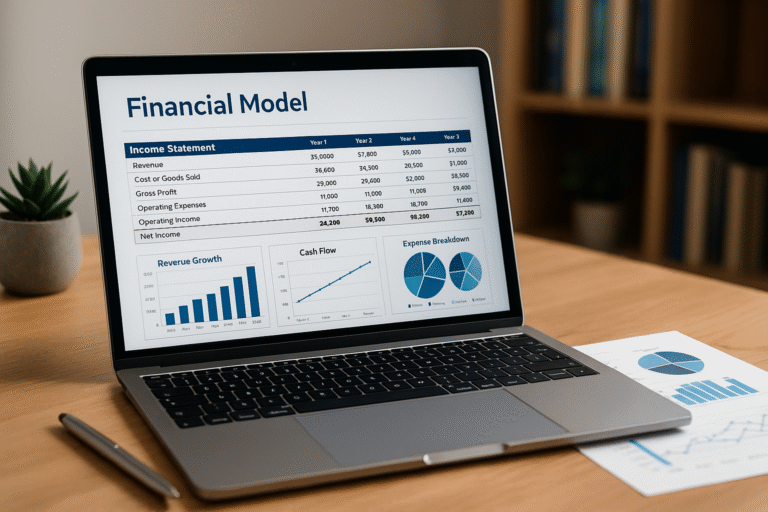
Modeling
Financial Models Built to Be Questioned
Seasonal costs against a level budget produce a variance report nobody trusts. Models we build put every assumption in one visible block, so the argument becomes about the assumption rather than about whether the spreadsheet is lying.
- Seasonal budgeting that matches how the money actually moves
- Scenario switching instead of five saved copies of one file
- Long-horizon projections a reviewer can follow line by line
- Cost per acre-foot and other measures the standard template will not give you
Related: Excel financial modeling

Support
On-Demand Help and Team Training
Sometimes there is no project, just a formula returning the wrong figure on the morning something is due. Screen share, work on your file while you watch, and you keep the explanation as well as the fix.
- Same-week help for something that has broken now
- Training on your own workbooks, not a generic exercise set
- Written handover so the tool survives a change of staff
- Retained hours for offices with no in-house Excel depth
Related: Excel expert help and MS Office training
What we get called about
The Conversations That Start a Yerington Project
Six openings we hear repeatedly, and roughly what happens after each one.
"There is a tab for every field and no way to see the whole farm."
Growth by copying, and it is the single most common thing we fix here. The contents are fine; the shape is wrong. Restructured onto one table with a column for field, season and crop, every existing view still works and the whole-operation question becomes a pivot rather than a week of manual comparison.
"Our budget is monthly and our costs are not."
Which guarantees a variance report that nobody believes and everybody ignores. Irrigation, planting and harvest do not spread evenly across twelve months, so the budget should not either. Rebuilding it around the actual season usually takes a day or two and makes the variance mean something again.
"The county submission takes a week we do not have."
Because it is being assembled rather than produced. Once the underlying records carry the fields the submission needs, the submission becomes a refresh. The deadline does not move, but the week does.
"These records have to hold up years from now."
Reclamation and environmental documentation gets read long after everyone involved has moved on. That means one calculation path per figure, assumptions written where a reviewer will find them, and nothing hard-coded inside a formula where it silently outlives its own reasoning.
"Only one person can run any of this."
In an operation this size that is a structural risk rather than a staffing gap. The answer is rarely another hire — it is documentation and automation, so the reporting keeps working during irrigation season when that person is unreachable for three days.
"The file has got slow enough to be annoying."
Usually a formula applied down a million rows, or an array formula doing a pivot table's job. Profiling it and replacing the expensive patterns typically returns the file to something instant, without removing a single feature anyone uses.
A quick diagnostic
Signs a Mason Valley Operation Has Outgrown Its Spreadsheet
Nobody schedules this work. It gets done when something finally breaks, or when a figure turns out to have been wrong for a season. These are the warnings that usually come first, and any three of them together are worth a free phone call:
- A tab per field, per year or per contract — and no way to see across them
- The whole-operation question takes a day to answer, so it stops being asked
- One person can run the reporting, and irrigation season makes them unreachable
- Numbers get corrected after submission often enough that people quietly double-check
- Nobody will touch the macros because whoever wrote them has gone
- Comparing this season to two seasons ago means rebuilding history by hand
- The file has grown slow and everyone has adapted rather than complained
- You have said "we should get a proper system" without ever pricing what that means
What it is costing already
The arithmetic is worth doing before deciding it is not urgent. One person spending five hours a week reassembling reports is about 250 hours a year on work that creates nothing new. In an operation with three or four people, that is a meaningful share of the total available time, and it is invariably the least interesting part of somebody's job.
The error cost is harder to see and usually larger. A broken lookup in a cost sheet does not announce itself; it produces numbers that look reasonable and inform real decisions about what to plant and where. The discovery comes later, from a contract reconciliation or an auditor, and by then the decision has already been made.
What actually happens first
Before anything gets proposed we look at the file and the routine around it. Fairly often the finding is that a couple of hours of restructuring removes the entire complaint, and the correct advice is to do that and stop.
Occasionally the finding is the opposite: the workbook has been asked to do a job Excel is genuinely wrong for, and the useful advice is to stop expanding it. Either way you get a straight answer at the end of a free consultation, including when the answer is that you do not need to hire anybody.
Work already delivered
Three Projects, and What They Actually Changed
Different clients, different sectors. The numbers below are the ones those clients measured after the fact.

66% better
accuracy
A budgeting tool for thirty entities
- The situation
- A management company responsible for thirty separate companies needed one budgeting tool that several people could work in without seeing or disturbing each other's figures.
- What we built
- A template with access levels, VBA that rolls each approved budget up into a master sheet, adjustable payroll, tax and benefits inputs, and a direct load into the accounting system at the end.
- The result
- Manual entry disappeared from the process. Budgeting accuracy improved by 66%, the build cycle sped up more than tenfold, and reforecasting during the year became something they could actually do.

40 hours
a month back
Operations reporting rebuilt
- The situation
- Operations reports were being updated by hand and sent both internally and to outside funding institutions. A single update cycle could take three days.
- What we built
- A program that pulls more than fifty sources into one document in about five minutes, lets the user inspect each source before building, and produces draft versions for comparison.
- The result
- What had taken up to eight hours now takes minutes, returning at least forty person-hours every month to work that is not data entry.

9 minutes
to 30 seconds
A workbook that had stopped being usable
- The situation
- Finding one record in a 1,200-row workbook was taking as long as nine minutes, caused by layered array formulas and code that had accumulated without review.
- What we built
- The data was moved onto proper Excel tables, pivot tables with slicers replaced the search logic, and the redundant VBA and array formulas were taken out rather than worked around.
- The result
- Retrieval fell to thirty seconds on exactly the same hardware — the file had never needed a faster machine, only a better structure.
Who this applies to
Industries We Work In
The six areas JAAD Group works across, described here as they show up around Yerington and the Mason Valley.

Finance and Accounting
Cash flow management, P&L tracking, budget analysis. In a county seat that mostly means submissions with fixed external deadlines and small teams behind them, where the work is making a month-end fit inside an afternoon.

Manufacturing & Logistics
Supply chain analysis, production scheduling, vendor performance. Around here that is agricultural inputs, packing and haulage against contracted volumes — and the reclamation contractors whose vendor records have to stay auditable.

Real Estate & Construction
Investment models, cost forecasting, expense tracking. Farm ground, leased acreage and the buildings on it, where the useful horizon is years and leases change hands between seasons.

Retail and E-commerce
Inventory monitoring, sales tracking, profit calculations. Agricultural supply and main-street trade, with slow-moving stock where the point of measuring is to find the lines that are quietly costing money.

Healthcare & Insurance
Patient record systems, policy tracking, compliance reports. Rural practices where one person handles scheduling, billing and compliance, so the tooling has to be small enough to maintain and complete enough to satisfy.

Education & Training
Enrollment reports, course progress dashboards, grant tracking. District and county programme reporting on submission dates set elsewhere, usually against more than one funding source at a time.
If your industry relies on Excel for financial analysis, data tracking or reporting, we can optimize and automate your workflows to save time and improve performance.

How a project runs
From First Call to Handover
Five stages. The first is free, and it fairly often ends with advice rather than a proposal.
A conversation and, ideally, the file
You describe what the workbook is meant to tell you and where it stops doing that. Sending the file makes this far more useful, but it is not a condition of talking.
Looking at the file and the routine around it
Where the data comes from, who touches it, what gets corrected by hand every time. In practice most of the real problem lives in that routine rather than in the formulas.
A written scope
What will be built, what it will do, what it costs. Fixed, because we have already looked. Open-ended hourly work on a scoped job is a way of transferring risk to the client.
Building in visible stages
You see working versions as they appear rather than a finished thing at the end. Corrections are cheap early and expensive late, which is the entire argument for working this way.
Handover that survives you leaving
Training on the actual tool, written documentation, and the source code. A solution only one person understands has moved the risk rather than removed it.
Who you will be dealing with
Jeff Mattus
Owner & President, JAAD Group
Jeff Mattus founded JAAD Group after more than twenty-five years building Excel and Office solutions, on a Computer Science background rather than an accounting one. That combination is the whole point: engineers tend to build elegant tools nobody in finance will use, and finance people tend to build tools that work right up until the day they silently do not.
The work has run across finance, healthcare, technology and real estate, which is a broader base than most Excel specialists have. It means the first call usually reaches a diagnosis quickly, because the problem in front of you has almost certainly turned up before wearing different clothes.
For a Yerington business the practical part is this: the person on the phone is the person who will scope the job and, in nearly every case, do it. Nothing is passed to an account manager, and nothing is handed to somebody who was not on the first call.
Organizations we have built for
Trusted With Business-Critical Spreadsheets














Why this rather than a general IT firm
What You Get From a Specialist
Excel is the whole business
Not one service line among twenty. That is why the diagnosis on a first call is usually right, and why the estimate that follows is usually close.
Repair is offered before rebuild
A rebuild is the bigger invoice, so it is worth saying plainly: if your file can be restructured rather than replaced, that is what gets recommended.
Distance genuinely does not matter
Screen share and shared files. A Mason Valley operation gets the same attention as one in Las Vegas, and nobody bills travel across Nevada.
Built for the next person
Documentation and training are part of the deliverable. Clever code only its author understands is a liability wearing a nice suit.
Outcomes that were measured
Hours returned, error rates, retrieval times. The figures on this page came from clients afterwards, not from a brochure.
The same person throughout
Scoping, building and handover done by whoever answered the phone. In an operation this size that continuity is most of the value.
Questions
Frequently Asked Questions
We are a farm, not an office. Does this apply to us?
Farm records are among the better uses of Excel, and among the worst maintained. Yield, input cost, water and delivery against contract are exactly the kind of structured, repeating data a spreadsheet handles well — provided it is set up as data rather than as a sheet per season.
The usual finding is not that a grower needs software. It is that eight years of good records are sitting in a shape that makes them unusable for the comparison that would actually inform next year's decisions.
Can you produce cost and yield per acre-foot of water rather than per acre?
Yes, and in this valley it is frequently the more useful number. Where water is the binding constraint rather than land, return per acre can point at a decision that return per acre-foot contradicts.
Most inherited farm workbooks cannot produce it, not because the maths is difficult but because allocation was never recorded at a level that allows it. That is a structural fix made once.
Our records have to stay defensible for years. Can you build for that?
That is a structural requirement rather than a presentational one. Every figure gets exactly one calculation path, assumptions live in one visible block rather than inside formulas, and nothing important is hard-coded somewhere a later reader will never look.
It is worth doing before a data set gets large. Retro-fitting traceability onto ten years of accumulated records costs several times what building it in would have.
How much does a project cost?
It depends on scope, which is why the first conversation is free and why we ask to see the file. A formula audit or one automated submission is a small fixed-price job. A multi-entity system with access levels and an accounting integration runs across stages.
Either way you get a written scope with a defined deliverable and a defined price before any build work starts.
Is our operation too small to bother?
Sometimes, and we will say so. If a workbook is genuinely doing its job, the honest advice is to leave it alone, and that answer costs you nothing because the consultation is free.
Where it is worth doing, small jobs often return more than large ones. A two-hour restructuring that removes a recurring weekly chore is worth more to a one-person office than a system would be.
Does remote work actually work from three hours away?
It is what makes this practical at all. The work is looking at your file together on a shared screen, which is identical whether we are in the next street or the next state.
It also means nothing is billed for travel, and an urgent problem gets looked at the same day rather than the same week.
Can you fix something built by someone who has left?
That is a large share of the work. We reverse-engineer how the file behaves, identify what is broken or fragile, and either repair it or rebuild the parts that cannot be saved.
The original author is not needed. What is needed is a conversation with whoever reads the output, because the difficult part is establishing what the numbers are supposed to mean.
How long does something like this take?
A single automated submission is often days. Restructuring a workbook that grew across several seasons is commonly one to two weeks depending on what the audit finds. A full system with access levels and an integration runs across several weeks in stages.
You have that estimate in writing before any build work begins.
What happens to the files when the work is finished?
They belong to you: the workbooks, the macro source code, and written documentation of how the whole thing works, plus training for the people who will use it.
Nothing is locked to us and no subscription keeps it alive. Ongoing support exists if you want it, and is never a condition of the tool continuing to run.
Do you only work in the industries listed on this page?
No. Those are where most of the work has sat, but the constraint is the problem rather than the sector. If it is a spreadsheet problem, it is in scope.
Reclamation records, a county budget, a hay contract, a dental practice rota — underneath, the job is the same one.
Also serving
Excel Consulting Across Nevada
The work is delivered remotely, so where you are makes no difference to what you get. Other Nevada towns with pages of their own:
Looking for a specific service? See Excel automation, VBA and macro development, Excel reporting, financial modeling, Excel consulting or Excel expert help.
Yerington is the hub here — schematic, not to scale
Send Us the File
Describe the problem, or just attach the workbook. You will get a straight answer about what is wrong with it and what fixing it would involve, before anything is agreed.
949-464-7489JAAD Group Excel Consulting · 2937 Hawksdale Dr, Las Vegas, NV 89134
Working remotely with Yerington and businesses across Nevada