
Richmond, Virginia · Independent city
Excel Consulting Services in Richmond, VA
A Richmond business of any size usually ends up serving three kinds of customer at once: state agencies, institutions, and ordinary private clients. Each wants the same work reported on a different basis, and the translation between them is almost always done by hand. JAAD Group provides Excel consulting in Richmond for the workbooks stuck in the middle.
- One record, three reporting bases
- Appropriation and grant periods
- Cost by contract line
- Automation and VBA
Three customers, three bases
The Same Work, Reported Three Different Ways
Most businesses have one way of reporting what they did. A Richmond business commonly has three, because the capital puts public agencies, institutions and private clients in the same market, and each of them asks for the work expressed against something different.
An agency wants cost set against an appropriation line and a state fiscal year that ends in June. An institution wants it against a grant or project period with its own eligible categories. A private client wants an invoice with a scope and a figure. These are not three formats of one number; they are three different ways of cutting the same effort.
What happens in practice is that the business keeps its records in whichever basis came first and translates into the other two manually at the end of each period. That translation holds real judgment, lives in one person's head, and takes a day or two every cycle to apply.
Underneath that sits a capital economy's other feature: a great deal of the work is won on cycles decided by somebody else's calendar, so the busy periods and the quiet ones are set outside the building.
What the work is really about
What Excel Consulting in Richmond Usually Involves
One record carrying every basis it will be reported on
The first and most valuable change is to record each piece of work once, with every dimension it will ever be reported against attached to it at the time. Not three sets of records that have to be reconciled, and not one set with two reconstructions on top — one record that carries the date, the client, the contract or grant it belongs to, the appropriation or project line where that applies, and the internal cost center. Capturing those at the point of entry costs a few extra keystrokes; reconstructing them afterward costs a day or two every period and gets harder the longer it is left. Once they are there, each of the three reports is a different view of the same data rather than a different document. That is the core piece of Excel consulting work in this city.
An appropriation line is not a cost center
The appropriation dimension deserves separate mention because it behaves unlike anything in commercial accounting. A line is funded for a period, it does not roll forward in the way a budget does, and spending against it has to be visible before the period closes rather than after. A business reporting into that structure needs to see its own committed and incurred cost against each line as the work proceeds, not at an invoice. The practical build is a running view per line, refreshed from the same records that produce the invoices, so nobody is maintaining a second set of figures for the agency's benefit.
A grant period is not a month
Grant and project periods bring the third basis, and the thing that catches people out is that the period boundaries are set by the funder and rarely match a month, a quarter or a year. Work spanning a boundary has to be split, and the split has to be consistent between periods or the totals stop reconciling. Holding the period as a dimension in the data rather than as a filter applied at reporting time is what makes that automatic. It also means a question about a closed period can be answered from the records instead of from a saved copy of the report.
The translation is judgment, so it has to be written down
Fourth, the translation between these bases contains real judgment — which overhead belongs to a funded line, how shared time is apportioned, what counts as eligible — and that judgment is currently in somebody's head. Writing it down as a stored set of rules, applied the same way every period with the exceptions listed rather than remembered, does two things. It makes the figures reproducible, which matters when they are examined. And it makes the process handoverable, which matters rather more the week that person is unavailable.
Work arrives on somebody else's calendar
Fifth, the timing of the work itself is largely outside the business's control, and that belongs in the forecast rather than in the explanation afterward. Procurement cycles, appropriation timing and institutional calendars all put the busy and quiet periods where they fall. A business that carries those as named inputs can plan capacity against them; one that forecasts on twelve smooth months will read a normal quiet stretch as a decline and make a hiring decision against the wrong signal. That is a straightforward piece of financial modeling.
None of this needs a new system
What none of this requires is new software. The time records, the invoices, the contract documents and the agency correspondence all exist; what is missing is a record structure that carries every basis from the start and a written set of rules for moving between them. That is days of work rather than a procurement exercise, and an hour of Excel expert help will usually establish how much of it applies to you.
What gets built
Excel Consulting Services in Richmond, VA — The Six Areas
Six kinds of work. For a business reporting to agencies and institutions, the first two cover most of what gets commissioned.

Structure
One Record, Every Basis Attached
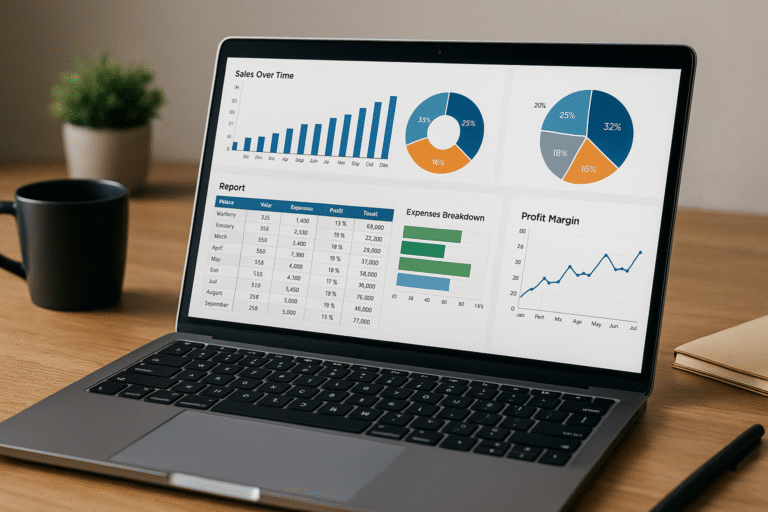
Date, client, contract or grant, appropriation line and cost center captured once at entry. After that each report is a view of the same data rather than a separate document.
- Every dimension captured at the point of entry
- Three reports, one dataset, with nothing to reconcile
- Formula repair for references that stopped pointing anywhere
- Performance — volatile formulas replaced with tables and pivots
Related: Excel consulting
Reporting
Spend Against a Line, While It Still Matters
A funded line has to be watched before the period closes, not after. Committed and incurred cost per line, refreshed from the records that already produce the invoices.
- Running view per funded line, not a period-end total
- Committed as well as incurred so commitments are visible
- Live connections to the systems already holding the data
- Exception flags when a line approaches its limit
Related: Excel reporting

Code
VBA for Rules That Must Not Drift
The judgment in translating between bases gets stored and applied identically every period, with exceptions listed rather than remembered, so the figures are reproducible.
- Stored rules instead of a remembered method
- Identical application every period, with a trail
- Validated entry so a line or period cannot be left blank
- Legacy macro repair where the author has moved on
Related: VBA and macro development
Automation
Period Submissions That Assemble Themselves
Anything produced on a fixed date from the same records should be generated. With three audiences on three calendars, that saving happens three times over.
- Scheduled generation for each audience and calendar
- Period boundaries handled where they split a piece of work
- Refresh from source rather than from a saved download
- Import cleanup for exports that shift format between runs
Related: Excel automation
Modeling
Forecasting on the Calendar That Drives You
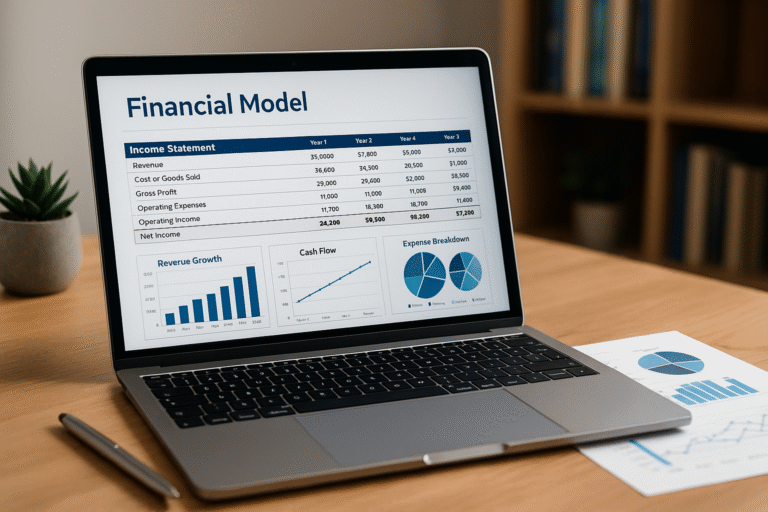
Procurement cycles and appropriation timing decide when the work arrives. Carried as named inputs, a normal quiet stretch stops reading as a decline.
- External calendars as inputs, not as explanations
- Capacity planned against the cycle rather than a flat year
- Scenario switching for a delayed or accelerated award
- Assumptions in one visible block, never inside formulas
Related: Excel financial modeling

Support
Expert Help and Team Training
Often there is no project, only a submission due this week that will not reconcile. A call, your own workbook on screen, and the reasoning left behind in writing.
- Same-week attention when a deadline will not wait
- Training on your own files rather than on sample data
- Written handover so the process survives a departure
- Retained hours where there is no in-house Excel depth
Related: Excel expert help and MS Office training
Where it starts
Eight Conversations That Begin a Richmond Excel Project
Openings we hear from businesses serving several kinds of customer, and what the answer usually turns out to be.
"We keep the same figures three different ways."
Which guarantees they will diverge. One record carrying every dimension produces all three as views, and there is nothing left to reconcile between them.
"Only one person can produce the agency submission."
Because the translation rules are in their head. Stored as rules with the exceptions listed, the process becomes reproducible and handoverable at the same time.
"We find out we overspent a line after the period closed."
Too late to act. A running view of committed and incurred cost per line, refreshed from the same records, moves that discovery to where it can still be used.
"Work spanning a period boundary never reconciles."
Because the split is applied at reporting time rather than stored. Holding the period as a dimension makes the split consistent and repeatable.
"A quiet quarter looked like a problem and was not."
Procurement and appropriation timing put the quiet periods where they fall. Carried as inputs, they stop being read as performance.
"An auditor asked how a figure was derived."
If each report is a view of one record, the derivation is available. If it was reconstructed by hand, it generally is not.
"Overhead gets apportioned differently each time."
Which is what happens when the method is remembered. Writing it down once removes both the inconsistency and the argument about it.
"The workbook takes a minute to recalculate."
Usually volatile functions across enormous ranges, or an array formula doing a pivot table's job. Rebuilt properly it is instant again with nothing removed.
A quick check
Signs a Richmond Business Has Outgrown Its Records
Nobody plans this work. It follows a submission that would not reconcile, or a question about a closed period nobody could answer. Earlier signals look like this:
- The same figures are kept in two or three parallel places
- Appropriation or grant lines are applied at reporting time, not stored
- Spend against a funded line is only visible after the period
- The translation between bases is in one person's head
- Work spanning a period boundary gets split differently each time
- Quiet periods are treated as performance rather than as the cycle
- A derivation cannot be shown when somebody asks for it
- Overhead apportionment varies between periods
What the manual translation costs
Two days a period of skilled finance time, spent producing figures that already existed in another shape, is the visible cost. It comes out of the person whose judgment you actually need on the substance rather than on the reformatting.
The larger exposure is reproducibility. A figure assembled by hand cannot be traced later, so a question from an auditor or a funder about a closed period becomes an exercise in reconstruction rather than a lookup, and the answer carries less weight for it.
What happens before a quote
We look at the records alongside the reporting cycle — who each submission goes to, on what basis, and what gets adjusted by hand between them. Those adjustments are where the real structure is hiding.
Frequently the conclusion is that capturing the dimensions at entry settles the whole complaint, and that is what gets recommended. Where part of this genuinely belongs with your accountant, you will be told so. The first conversation is unpaid either way.
Work delivered
Three Builds and the Figures Clients Recorded
Real projects for real organizations. Each number came from the client once the tool was in routine use.

66% better
accuracy
A budget tool across thirty companies
- The position
- A management company carrying thirty separate businesses budgeted each one alone and merged the results by hand, while several people needed different levels of access to one workbook.
- The build
- A budgeting template with security tiers, VBA rolling each approved budget into a master sheet, adjustable payroll, tax and benefits inputs, and a direct load into the accounting system.
- The outcome
- Hand entry left the process entirely. Accuracy improved by 66%, the build cycle ran more than ten times faster, and reforecasting part-way through the year became realistic.

40 hours
a month back
Manual operations reporting replaced
- The position
- Reports for internal management and for external funding institutions were maintained entirely by hand, with one update cycle running as long as three days.
- The build
- A program drawing more than fifty sources into one document in about five minutes, with each source inspectable beforehand and drafts produced for comparison.
- The outcome
- An eight-hour task now finishes in minutes, returning at least forty person-hours each month from work that produced nothing new.

Nine minutes
to thirty seconds
A workbook that had stopped performing
- The position
- Retrieving one record from a 1,200-row workbook could take as long as nine minutes, caused by layered array formulas and years of code added without review.
- The build
- Data moved onto native Excel tables, pivot tables with slicers replacing the lookup logic, and the redundant VBA and array formulas removed rather than worked around.
- The outcome
- Thirty seconds for the identical retrieval on identical hardware. The constraint had always been structure rather than processing power.
Who we work with
Industries We Serve in Richmond
The six areas JAAD Group covers, described as they appear in the capital.

Finance and Accounting
Cash flow management, P&L tracking, budget analysis. Finance functions producing the same figures on three different bases every period.

Education & Training
Enrollment reports, course progress dashboards, grant tracking. Programs reporting against funder periods and eligible categories rather than their own year.

Healthcare & Insurance
Patient record systems, policy tracking, compliance reports. Providers and administrators whose reporting is shaped by bodies outside the building.

Real Estate & Construction
Investment models, cost forecasting, expense tracking. Contractors working to procurement calendars rather than ordinary commercial ones.

Manufacturing & Logistics
Supply chain analysis, production scheduling, vendor performance. Suppliers whose order pattern follows an appropriation cycle.

Retail and E-commerce
Inventory monitoring, sales tracking, profit calculations. Trade in a city whose working population is set by institutions and government.
If your industry relies on Excel for financial analysis, data tracking or reporting, we can optimize and automate your workflows to save time and improve performance.

How it runs
Working With an Excel Consultant in Richmond
Five stages. The first costs nothing, and a fair number of them end there with advice rather than a proposal.
Say who you report to
Which audiences want the work expressed which way, and where the translation between them breaks. Sending a recent submission makes the call far sharper.
Audit the records and the cycle
What gets captured at entry, what gets added later, and what is adjusted by hand between submissions. Those adjustments are the real structure.
A written scope with a price
Both agreed before building starts. The records have been read by then, so leaving either open-ended would be a choice rather than a necessity.
Build where you can see it
Working versions as they appear rather than one delivery at the end. A correction in week one is cheap; the same correction in week four is not.
Hand over properly
Workbooks, macro source code, a written account of the translation rules, and training for whoever produces the submissions.
Who does the work
Jeff Mattus
Owner & President, JAAD Group
JAAD Group is Jeff Mattus, who founded the practice after more than twenty-five years building Excel and Office systems, approaching the work from Computer Science rather than accountancy. Where one set of records has to answer to three audiences, that background is what keeps the structure sound instead of merely tidy.
The work has covered finance, healthcare, technology and real estate. That breadth is why a first conversation usually produces a diagnosis rather than a discovery phase: a three-basis reporting problem has close relatives in consolidation work across industries with no public funding anywhere near them.
Everything is delivered remotely, so a Richmond engagement works exactly as a local one would. The person who takes the first call scopes the job and then builds it, with no handover to somebody who missed the conversation.
Organizations we have built for
Trusted With Business-Critical Spreadsheets














Why a specialist
Why Richmond Businesses Use a Dedicated Excel Consultant
One discipline only
Excel, VBA and Office automation are the whole practice, which is why a first-call diagnosis is usually right and the estimate close to the final figure.
Built to be examined
Where a figure may be questioned by an auditor or a funder, each number has to carry its derivation rather than having been assembled by hand.
Rules stored, not remembered
The judgment in translating between bases is real. Writing it down makes the figures reproducible and the process handoverable at once.
Clear about the boundary
What is eligible and what must be declared is a question for your accountant. Holding the right facts and computing consistently is ours.
Measured, not asserted
The outcomes above were recorded by clients in live use, and each project is set out in full further up this page.
Remote and immediate
Screen share rather than scheduling, so a submission due this week gets attention the same day and no part of the fee is travel.
Questions
Frequently Asked Questions
What does Excel consulting in Richmond usually involve?
Most often it is restructuring so a piece of work is recorded once with every dimension it will be reported against attached, instead of being kept two or three ways and reconciled.
After that it is a running view of spend against funded lines, period handling where a funder's boundaries do not match a month, and automating the submissions themselves.
We keep the same figures in three places. Is that avoidable?
Yes, and it is usually the first thing to fix, because parallel copies always drift and the drift is discovered during a submission rather than in ordinary work.
Capturing the client, the contract or grant, the funded line and the cost center at the point of entry turns three sets of records into three views of one.
Why does an appropriation line need different treatment?
Because it does not behave like a budget. It is funded for a period, it does not roll forward the same way, and spend against it needs to be visible before the period closes.
The practical answer is a running view per line, showing committed as well as incurred cost, refreshed from the same records that produce your invoices.
Work spanning a grant period never reconciles. Why not?
Because the split is being applied when the report is produced rather than stored with the record, so it comes out slightly differently each time.
Holding the period as a dimension in the data makes the split consistent between periods and lets a closed period be answered from the records rather than from a saved report.
Can the translation between bases be automated?
The mechanical part, yes. The judgment in it — which overhead belongs where, how shared time is apportioned — stays judgment, but it can be written down once and applied identically.
What that buys is reproducibility and a process somebody else can run, which matters most in the week the usual person is unavailable.
Our quiet quarters worry us. Are they real?
Often they are the cycle rather than the business. Procurement timing and appropriation calendars put the quiet stretches where they fall, outside your control.
Carried as named inputs rather than discovered afterward, they stop being read as performance and start being something you plan capacity around.
How much does an Excel consultant cost?
Scope decides it, which is why the records are examined before any figure is discussed and why that examination is free. A formula audit or one automated submission is small and fixed-price.
In every case the deliverable and the price are agreed in writing before any building begins.
Do you work on site in Richmond?
The work is delivered remotely by design. Reviewing a workbook together on a shared screen is identical at any distance, and it means a submission due this week is looked at this week.
It also keeps travel off the invoice, which on a smaller engagement is a real share of the cost.
The person who built our reporting has left. Is that a problem?
It describes a large share of the work here, and it is workable. The file gets read back to first principles, the fragile sections identified, and each repaired or replaced as warranted.
Their absence is not the obstacle. Time with whoever produces the submissions now is, because the conventions they apply matter as much as the formulas.
How long does a project take?
Capturing the dimensions properly is often a week. Adding funded-line reporting, period handling and automated submissions usually runs one to two weeks more.
That estimate is committed in writing before build work starts rather than discovered along the way.
What do we receive at the end?
The workbooks, the macro source code, a written account of the translation rules and how each view is derived, and training for the people who will run it.
Nothing is locked to us and no subscription is needed to keep it working. Support afterward is available and entirely optional.
Do you only work in those six industries?
No. They describe where most of the work has come from rather than a restriction, and what decides scope is the nature of the problem rather than the sector.
A three-basis reporting structure, a funded-line view, a period split and a clinic rota have far more in common underneath than they appear to.
Also serving
Excel Consulting Across Virginia
This is remote work, so your address makes no difference to what gets delivered. Other Virginia cities with pages of their own:
By service: Excel consulting for the record structure, Excel reporting for funded lines, Excel automation for the submissions, VBA and macro development for the stored rules, and financial modeling or Excel expert help for the rest.
Richmond is the hub here — schematic, not to scale
Send Us the Workbook
Describe who you report to and where it breaks, or attach a recent submission. You will get a straight assessment of what is wrong and what fixing it involves, before anything is agreed.
949-464-7489JAAD Group Excel Consulting · 2937 Hawksdale Dr, Las Vegas, NV 89134
Excel consulting services in Richmond, VA and across Virginia, delivered remotely