

This is a question I get asked more than almost any other. A business reaches a point where their Excel work has gotten serious. Models breaking, reports taking too long, automations that nobody knows how to fix. The person in charge has to decide: do we hire someone full-time, or do we bring in a consultant?
I am going to give you an honest answer. Not a sales pitch. An actual breakdown of when each option makes sense, what the real costs look like, and the questions you should be asking before you make the call.
Because I have seen both decisions go wrong. I have seen companies hire full-time Excel analysts who sat idle for months because the work was not consistent enough to justify a salary. And I have seen companies cycle through consultants for years when a dedicated hire would have paid for itself inside six months. The decision matters, and it deserves more than a gut feeling.
The Real Cost of Hiring In-House
When most people think about hiring an in-house Excel analyst, they look at the salary number and stop there. That is the first mistake.
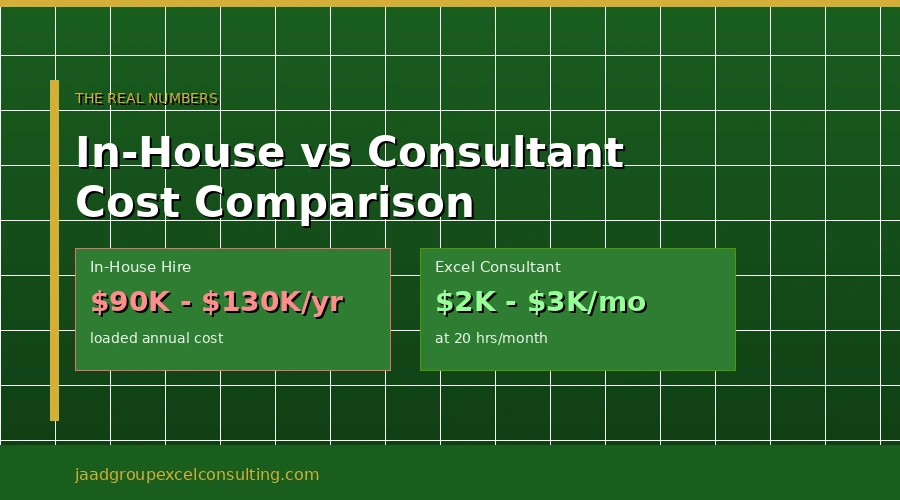
A mid-level Excel analyst in the United States earns between $65,000 and $95,000 per year in base salary, according to Glassdoor’s 2025 Excel analyst salary data. But that is not what you are actually paying. Once you factor in payroll taxes, health insurance, paid time off, retirement contributions, equipment, software licenses, and the management time required to onboard and direct that person, the loaded cost typically lands between $90,000 and $130,000 per year for year one.
Then there is the hiring process itself. Job postings, recruiter fees if you use one, interview time across multiple team members, and the time between when you start looking and when someone actually starts work. That gap is typically two to four months. During that window, your Excel problems do not pause.
And once the person starts, you are looking at another one to three months before they are fully productive. They need to learn your systems, your data, your workflows, your preferences. That is a significant investment of time before you see a return.
That said, an in-house hire makes genuine sense in certain situations. If you have 30 or more hours of sustained Excel work every week, if your work requires deep institutional knowledge that builds over time, or if you need someone available immediately and consistently throughout the business day, a full-time hire can absolutely be the right call.
The Real Cost of Hiring a Consultant
An Excel consultant with serious experience charges between $75 and $200 per hour depending on specialization. For advanced VBA development and Excel financial modeling, rates typically fall between \$100 and \$150 per hour for quality work.
That sounds expensive compared to a salary until you do the actual math.
If your business needs 20 hours of Excel consulting work per month, that is $2,000 to $3,000 per month at professional rates. Compare that to $8,000 to $11,000 per month for a fully loaded in-house hire. For a business with project-based or inconsistent Excel needs, the difference is significant.
The other thing most people overlook is what you are actually getting with a consultant. You are not paying for someone to learn Excel. You are paying for someone who has already solved the specific problem you have, probably dozens of times, in different industries. The learning curve is yours to absorb with an in-house hire. With a consultant, you are buying the result of someone else’s learning curve.
A good Excel consultant also brings no overhead. No desk. No laptop. No software license. No management time beyond the project itself. You pay for the work. When the work is done, the engagement ends. If you need more, you pick it back up.
Where Consultants Win
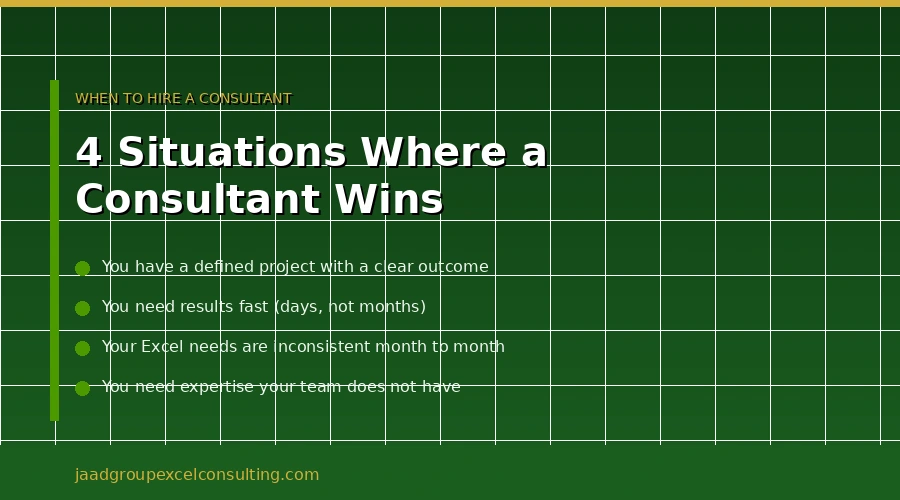
You Have a Defined Project With a Clear Outcome
A new financial model. An automated reporting system. A VBA macro that handles a process your team currently does by hand. These are projects with a beginning, a middle, and an end. A consultant delivers the result and hands it over. You do not need a full-time employee for a finite piece of work.
You Need Results Fast
Hiring takes months. A consultant can start in days. If your Excel problem is costing you time or money right now, the speed advantage matters. I have had clients come to me with broken models a week before a board presentation. That is not a situation where a four-month hiring process helps anyone.
Your Excel Needs Are Inconsistent
Some months are heavy. Others are light. An in-house hire costs the same either way. With a consultant for Excel work, you scale up when you need it and step back when you do not. Variable cost versus fixed cost. That distinction matters a lot to smaller and growing businesses.
You Need Expertise Your Team Does Not Have
Advanced VBA development, complex financial modeling, or full Excel automation builds require a specific depth of experience that is genuinely hard to find in a generalist hire. Most Excel analysts are competent in the tools. Very few have built serious automation systems across multiple industries. When that expertise gap exists, a specialist consultant closes it faster and more reliably than trying to hire for it.
Where an In-House Hire Wins
You Have Constant, High-Volume Excel Work
If someone in your business could legitimately fill 35 to 40 hours a week with Excel work for the foreseeable future, the economics shift in favor of a full-time hire. At that volume, a $90,000 annual loaded cost is almost always cheaper than consultant hours.
You Need Someone Deeply Embedded in Your Business
Institutional knowledge matters. A consultant who works with you for two months will understand your systems at a surface level. A full-time analyst who has been with you for two years knows the quirks in your data, the history behind your models, and the preferences of every stakeholder they report to. That knowledge has real value.
You Need Immediate Availability Throughout the Day
Consultants manage multiple clients. Response times are measured in hours, not minutes. If you need someone who can drop everything at 2pm on a Tuesday to fix a report before a 3pm meeting, a full-time hire is what that situation requires.
You Have a Manager Who Can Oversee the Work
This one gets overlooked. An in-house hire needs direction. They need someone who can evaluate their work, give them feedback, and course-correct when projects go sideways. If you do not have that person internally, you will spend management time on something you are not equipped to manage and the results will reflect it.
The Decision Framework
Here are the questions I would ask before making this call:
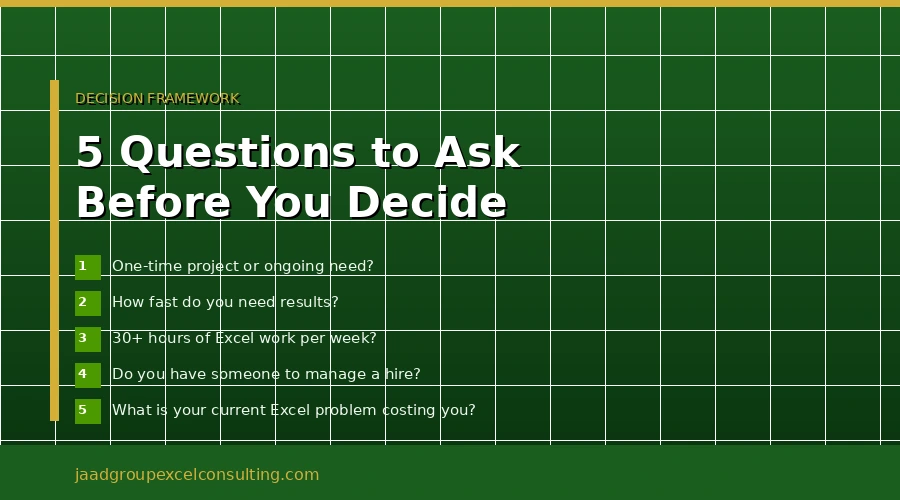
Is this a one-time project or an ongoing need? If it is one-time, start with a consultant every time.
How fast do you need results? If urgency is real, a consultant wins on speed.
Do you have 30-plus hours of Excel work per week consistently? If yes, the economics of a full-time hire start to work. If no, they probably do not.
Do you have someone who can manage an analyst effectively? If not, a consultant manages themselves and delivers against agreed outcomes.
What is the cost of your current Excel problem? If broken models, slow reports, or manual processes are costing your business time and money every month, that cost is real. Factor it into the comparison.
The Honest Answer
For most small and mid-sized businesses, the right answer is to start with a consultant. Get the foundational work built properly. Automate the processes that are draining time. Build the models that need to be built. Then evaluate whether the ongoing maintenance and new work justifies a full-time hire.
What I see most often is businesses that go straight to hiring and end up with a generalist who can handle basic Excel work but cannot build the automation or modeling infrastructure the business actually needs. Then they bring in a consultant anyway to fix what the hire could not do and they have paid for both.
At JAAD Group, I work with businesses exactly at this inflection point. Some come to me for a specific project and we are done in a few weeks. Others work with me on an ongoing basis because the volume and complexity of their Excel needs justifies it. Either way, the work is handled personally by me. Not delegated. Not templated. Built around your business specifically.
If you are trying to figure out which path makes sense for your situation, a free consultation is the right starting point. We talk through your current setup, what you actually need, and whether bringing in outside help makes sense at all. No pressure. Just a straight answer.
Call JAAD Group: 949-464-7489 Visit: jaadgroupexcelconsulting.com